Showing posts with label Identity. Show all posts

Monday, November 19, 2007

My Grandmother and the "Storage Barn"


My mother and I went up to Claremore, Okla. to see my Cherokee Grandmother after my sister Kara ran in a marathon in Tulsa yesterday. Grandmother was recently diagnosed with alzheimer's and has been in a nursing home for about two months. She has spent a short time in the hospital because she got medications all mixed up and took too much aspirin which ate up the lining in her stomach almost bleeding her out.

Grandmother looks good for 90 years old and was in good spirits. She was pleasant and polite and conversational... on the surface. There isn't much depth left. She doesn't have much short term memory left at all. She kind of lives in the moment with no real understanding of where she is and why. She pretty much thinks she's there as a volunteer worker for all the other poor souls filed away there to die. She does not see herself as a patient. She says she feels great. She walks the halls praying for all the other residents like she did for years at the Veterans Hospital. Everyday she gets up out of bed, bathes, gets dressed, eats breakfast and then gathers her things waiting for someone to come and get her and take her home. To pass the time she walks about watching the birds and the plants outside the windows and praying over the other residents that are upset and hurting. She says she's been busy and met a lot of nice people but she's ready to go home now...

"we can go right now if you want... I'm packed and ready," she says.

She talked about wanting to go home and get her porch painted a different color and do some yard work, raking leaves and cleaning out the gutters. Its gut wrenching to deal with. Every time there is a pause in conversation she slips in how anxious she is to get home.

She also speculates about living elsewhere and offers, "If there's anything I can do to be of service I'll do it. The busier I am the happier I am and the better I feel. I can pay for the gas to drive me home or out to see my brother Ralph or my son. I'll bet I can do some work there. There's lots of Indian people and other handicapped I can minister to." The thought that she will be living in the nursing home or "storage barn" as she ironically calls it, seems out of the question to her.

The saddest part is that she definately is not going to get better or last very long where she is. She gets little or no exercise or mental stimulation or any kind of therapy that might help her mentally. Its unbelievable to me that it is so expensive to basically put someone in storage in a nursing home til they die and there is such little return. Rooms at the Motel 6 are roomier and better furnished. Nursing homes are filled because the families of the residents are pretty much all wage slaves and have to work and are thus unable to be caretakers.

I am strongly considering leaving my employment and moving up there to be her companion and caretaker. All I would need is basic expense money which I can guarantee you is a lot less that what is being paid to that "storage barn". Still this would be a major commitment. Yet, if I can work it out I will do that and do some writing and perhaps even finish my degree while up there as well.

Prayers for us are greatly appreciated. I could also use some advice on things that can at least slow her mind from deterioration and/or entropy.

I found some clips about being there for alzheimer's patients recently. They have really hit home with me now. Take a look at this:


Also, there are several more powerful and moving clips about alzheimer's patients and their humanity and dignity and how to be present for them here:

http://www.memorybridge.org/videos.php

Friday, November 02, 2007

But... what about the dinosaurs?


video- Walking In Your Footsteps by The Police

I am a Christian. I am a blogger. I am someone who grapples with life's larger questions on a moment to moment basis. In cruising around the Internet and monitoring the ongoing debate between Christians of differing theological interpretations and Christians and scientists and/or Christians and atheists there is one persistent question that just keeps popping up. How old is the earth? some Christian literalists seem to believe that if they don't do the math just a certain way and give in to the notion that the earth is only about 4-6 thousand years old that they are somehow being heretical... disrespecting God and rejecting his Holy Word, the Bible.

Well, I tell you right now that I am a Christian who believes the Bible and I find the notion that the earth is less than ten thousand years old... well... not very believable. To be fair, I don't necessarily believe that the earth as we know it is hundreds of millions of years old either.

As for the Christian "literalists", the literalism seems to be one of convenience... after all the Bible also says to love your enemies and those whom may not agree with you. I know very few Christians who pay much attention to that passage- let alone do intellectual gymnastics to realize and/or internalize it in their everyday lives. "Conservative" and liberal Christians do not even speak civilly to one another for the most part let alone to unbelievers and the lost. I digress.

I don't think that the account of origins as it is given in Genesis is meant to be an encyclopedia like telling of exactly what, when and how things began. Neither is it a totally figurative allegory. The plain fact of the matter is that it only tells us about God as Creator and the original purposes and intentions for mankind. It also tells about the entry of evil into the world and sets the stage for the battle of evermore between the Spirit of Truth and the Father of Lies.
You can take those items to the bank. As far as the exact chronology or timeline... who knows?
Anyone that claims they do know is mightily conceited. The bible does NOT give us that information.

Science gives us a spotty, incomplete and often biased opinion on these matters as well. The academic system works a lot like the media, organized religion or any other institution... anomalous evidence and/or dissenting opinion is squelched as much as possible in the interests of the corporate survival of the institution. Objectivity and truth often take a back seat to the god of money and agenda.

Let me just say this by way of offering my own thoughts on how old the earth might be. I have been to a place where on a raggedy, rocky knoll in Utah, near the Dinosaur National Monument there is a giant fossilized squid. My rational mind tells me that this as well as the rest of the fossil record and all the fossil fuels under the ground did not form in 6,000 years or less. In fact, I find such an idea absurd. I could be wrong of course. Yet, I find this idea almost as absurd as the idea that all the harmony, complexity, order, life and intelligence in the cosmos just happened by sheer mathematical chance and accident... but not quite. If one then insists that life and such came from God- this of course leads to the question of where God came from if there be such a thing. Once again, no man can really answer questions like that. I suppose theorizing on it is a worthy enough enterprise.

But, a lot of people... indigenous people Like Native Americans and/or Christians un-indoctrinated or unaffected by the western mindset and the desire to categorize, master and explain everything surrender questions and desires concerning exactly when, where and why. Instead they worry themselves with another question... perhaps the only one that really matters after all...HOW or WHAT is the right way to live... or what is one's proper relationship to all things? I stand with those who grapple mostly with that question. Now, as a Christian let me say this... those answers can be found in Christ and I believe nowhere else. That is the only reason I am still a Christian. Believe me I know what a monumental task it is to try and convince someone of this if they do not first accept the Bible as a reliable source of information. The truth is no person can ever talk somebody into something they do not want to be true. Real understanding of these matters comes by spiritual means... in fact they are considered as a gift.
Again... if one does not allow for spiritual reality, then there is no sense trying to speak spiritual language to one who does not or will not hear it.

Well... I started writing this with but one question to pose and then got into the stream of consciousness. Anyway.... how old do you think the earth is? Maybe the better question is... does it really matter to how you will live your life?

Thursday, September 27, 2007

Proud to be an American-Christian! (If you don't like it, you can go to @#%*!)


Did the title of the post wake you up? It is just a little bit provocative, I will admit. But, I hoped to wake up your reasoning ability, because the problem with carnality is, that it is never farther away than your heart, i.e. the physical pump beating in your chest at this very moment.


This post is based on something that has occurred to me over time, since I taught a Wednesday Evening bible class just over a year ago. The title of the lesson was "When Faith & Politics Meet". I have posted the lesson in most of my blogs and have posted most of it here on Scott’s blog as well.

I see this bumper sticker quite often that says “I am Proud to be an American”, the magnet version is in the picture posted above right. (Whoops! How did that get in here?)

It is a point that Scott has encouraged me to contemplate, because the attitude that is revealed will necessarily divide humanity between America and others.


However, the goal of the Lord is, and always has been, to have all barriers removed from between individual men and women as well as from between humanity and God.
St. Paul certainly recognized this, look at the following passage and think about the pride within the bumper stickers.
"Power of Pride" indeed.


Galatians 3:26-29, 26 So you are all children* of God through faith in Christ Jesus. 27 And all who have been united with Christ in baptism have been made like him. 28 There is no longer Jew or Gentile,* slave or free, male or female. For you are all Christians—you are one in Christ Jesus.(emphasis added by the Holy Spirit. If you don't believe it, just ask Him!) 29 And now that you belong to Christ, you are the true children of Abraham. You are his heirs, and now all the promises God gave to him belong to you.
*
Galatians 3:26
Greek sons.
*
Galatians 3:28
Greek Jew or Greek.
Holy Bible : New Living Translation. 1997 . Tyndale House: Wheaton, Ill.

To the above passage we might add 'there is no American or European'.

Nevertheless, we have jumped headlong into the very trap, about which Paul warned the Galatian Church.

And furthermore, we do it gladly with pride. We boast arrogantly about our nationality and our state of birth. We stick red, white and blue magnetic slogans on our cars, such as; "The Power of Pride". All the while we forget that the the power of pride is death..., always & without exception. Pride is a dead end street.

It is only by humility that we become like our Lord Jesus Christ. I do not see Jesus walking around Palestine, for the three years of his ministry, carrying a placard that said "Proud to be a Jew". Consider this final section from St. Paul's letter the the Galatians.

Galatians 6:14-16, 14 As for me, God forbid that I should boast about anything except the cross of our Lord Jesus Christ. Because of that cross,* my interest in this world died long ago, and the world’s interest in me is also long dead. 15 It doesn’t make any difference now whether we have been circumcised or not. What counts is whether we really have been changed into new and different people. 16 May God’s mercy and peace be upon all those who live by this principle. They are the new people of God.*
*
Galatians 6:14
Or Because of him.
*
Galatians 6:16
Greek the Israel of God.
Holy Bible : New Living Translation. 1997 . Tyndale House: Wheaton, Ill.


Does the passage above have anything in common with with a philosophy of division or superiority?
As for me, God forbid that I should boast about anything except the cross of our Lord Jesus Christ.

What if we did our "identity-pride" based on our galaxy, the Milky Way, instead of all of the other ways, e.g. by nationalism, sports teams, automobile manufacturers, etc.?

We would be far more unified with this approach to division?

Instead of seeing bumper stickers that read "Texas Native" or "Proud to be an American", we could just have "Proud to be a Milky Wayan" or "Proud to be a Milky Wayfarer".


God bless,
DSM

Saturday, September 22, 2007

The Man's Too Strong- Dire Straits


I'm just an aging drummer boy
And in the wars I used to play
And I've called the tune
To many a torture session
Now they say I am a war criminal
And I'm fading away
Father please hear my confession

I have legalised robbery
Called it belief
I have run with the money
I have hid like a thief
I have re-written history
With my armies and my crooks
Invented memories
And I did burn all the books
And I can still hear his laughter
And I can still hear his song
The man's too big
The man's too strong

Well I have tried to be meek
And I have tried to be mild
But I spat like a woman
And I sulked like a child
I have lived behind walls
That have made me alone
Striven for peace of mind
Which I never have known
And I can still hear his laughter
And I can still hear his song
The man's too big
The man's too strong

Well the sun rose on the courtyard
And they all did hear him say
You always was a Judas
But I got you anyway
You may have got your silver
But I swear upon my life
Your sister gave me diamonds
And I gave them to your wife '
Oh Father please help me
For I have done wrong
The man's too big
The man's too strong

Wednesday, September 19, 2007

He Reigns- Newsboys


I have been suffering and struggling for the last few days with some of my own private tortures. I had dinner tonight with my father and had a wonderful and relevant conversation. I was just driving home from dinner and my mind began to unravel a bit with the things I have been wrestling with. I felt on the edge. I was cruising through the radio stations looking for something to distract me or else give me a bit of hope or encouragement ... something to dull the pain... I caught the very beginning of this song... a song I had never heard before. After a few bars I began to cry... I cried in mixed joy and sweet pain. I nearly had to pull over. It was a powerful, cleansing cry. I needed that. What an awesome tune. It was just what I needed. It brought me peace. I am grateful.

He Reigns lyrics:

It’s the song of the redeemed
Rising from the African plain
It’s the song of the forgiven
Drowning out the Amazon rain
The song of Asian believers
Filled with God’s holy fire
It’s every tribe, every tongue, every nation
A love song born of a grateful choir

It’s all God’s children singing
Glory, glory, hallelujah
He reigns, He reigns
It’s all God’s children singing
Glory, glory, hallelujah
He reigns, He reigns

Let it rise above the four winds
Caught up in the heavenly sound
Let praises echo from the towers of cathedrals
To the faithful gathered underground
Of all the songs sung from the dawn of creation
Some were meant to persist
Of all the bells rung from a thousand steeples
None rings truer than this

It’s all God’s children singing
Glory, glory, hallelujah
He reigns, He reigns
It’s all God’s children singing
Glory, glory, hallelujah
He reigns, He reigns
It’s all God’s children singing
Glory, glory, hallelujah
He reigns, He reigns
It’s all God’s children singing
Glory, glory, hallelujah
He reigns, He reigns

And all the powers of darkness
Tremble at what they’ve just heard
‘Cause all the powers of darkness
Can’t drown out a single word

When all God’s children sing out
Glory, glory, hallelujah
He reigns, He reigns
All God’s people singing
Glory, glory, hallelujah
He reigns, He reigns

Thursday, September 13, 2007

The New Great Commission, from the American-Christian Perspective


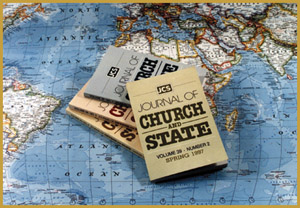
Have a look at an interesting editorial from the Baylor University's, J.M. Dawson Institute of Church-State Studies.

The author is Dr. Charles McDaniel of the University Department of Church-State Studies.

But, before you venture off to some exciting blog with scantly clad co-eds, let me temp you with my unique brand of theology.

That's right, in lieu of slightly dressed blonds, brunettes, and red-heads, I give you God and philosophy.

I have been thinking about this publication (Journal of Church and State) since reading on this very blog, Mr. Starr's post from late last night, about the James Dobson radio program.

Dr. McDaniel looks at the Iraq experiment from a totally secular and carnal angle.

Albeit it does appear that he comes down as saying that "the Iraq war is wrong", the Doctor never asks the question if Jesus Christ, or if the Holy Father, or if the Holy Spirit want a "democratized" world. Therefore, I would have to presume that he believes that the answer to these questions are either irrelevant or that it is self-evident.

What passage does one turn to for the Creator's opinion of the various carnal forms of secular government.

I appears to me that Dr. McDaniel seems to be encouraging Americans to come up with an objective standard for who we should "help" with democracy, rather than addressing the issue of humanity's need for eternal redemption.

It is a curious way of dealing with discipleship. This editorial title, Winning Hearts and Minds, is interesting, considering the fact that he's not talking about winning souls for Jesus.

What Dr. McDaniel is talking about, is instead, that "we" should be converting folks to an American economic, social, political, & cultural system.

I might ask; 'who are we'?, Should we see ourselves as citizens of the Kingdom of Heaven or as Americans? And what happens when our American citizenship opposes our Kingdom of God citizenship? Do we hold our American title close to our hearts and push the Spiritual away? Do we ever read Luke 16:13 or Matthew 6:24;

“No one can serve two masters. For you will hate one and love the other, or
be devoted to one and despise the other. You cannot serve both God and
money.”
Holy Bible : New Living Translation. 1997 . Tyndale
House: Wheaton, Ill.
The contention of Dr. McDaniel is an obvious attack on Christ's charge to the disciples in Matthew 28 and Mark 16, albeit passive, it is an attack nonetheless, on the Great Commission.

  • 15 And then he told them, “Go into all the world and preach the Good News to everyone, everywhere..."
    Holy Bible : New Living Translation. 1997 . Tyndale House: Wheaton, Ill.

Anyway, here are the scantly clad words of an American-Christian.


Winning Hearts and Minds
by Dr. Charles McDaniel


A troubling aspect to the present reconstruction of the world order is the fine line in decision-making either to "win over" or "wall off" the hearts and minds of a people. Terrorism is said to have forced our hands in these decisions; yet the criteria by which one national or ethnic group is granted entry to the global society even as others are rejected remain largely undefined. The strategic interests of the industrialized world undoubtedly are a factor, but caprice appears to influence these choices as well. Some, like the Iraqis, are selected for democratization, a process that includes the modernization of that country's institutions and major capital investments in its infrastructure. Other peoples, such as the Palestinians, are written off as a lost cause. Their fates are the internment camps like the ones being constructed by the Israeli government in its system of settlements, inaccessible highways, and concrete walls. Chechnyans, Tamils, Punjabis and many other ethnic and religious groups are potential candidates for this system that Professor Marc Ellis of Baylor's Center for American and Jewish Studies has described as "ghettoization."


How is it that Iraq was selected to become the beacon of democracy in the Middle East? Did it arrive at some undefined threshold of suffering that triggered Western (and specifically American) intervention? Does it pose a greater threat to the global order than North Korea or Iran? If Operation Iraqi Freedom was initiated for humanitarian reasons, how can we now resist intervening in the ethnic cleansing presently underway in Sudan? If it was a utilitarian decision, how much longer can we avoid action to curb the obvious threat posed by Kim Jong Il? Did American policy-makers weigh the probability of success against the investment required for Iraq's liberation and determine that Iraq is the best use of the developed world's limited democratization resources? These questions do not result from cynicism or second-guessing; they are intended to point out the need to arrive at consistent methods by which we target nations for "value reconstruction" and the necessity for constant reassessment of these efforts.
Many of the claims used to justify the Iraq War are true. Saddam Hussein was a ruthless dictator who posed a real threat not only to Iraq's neighboring states but also to populations within its borders. He exhibited the willingness to use the most heinous weapons against Iranian soldiers and even his own people and assuredly would have done the same to Israelis, Kuwaitis, Jordanians and others had he been given the opportunity. Yet the Saddams of the world have persisted throughout history. He will assume a position in the pantheon of political infamy alongside Hitler, Mussolini, Stalin, Pol Pot, Kim Jong Il, and others who, sadly but assuredly, will follow. The brutality and irrationality of particular regimes must be elements of the decision to forcibly democratize an oppressed people, but they should not be exclusive criteria.


The calculus by which we target nations for future liberation is, in certain ways, a repugnant analysis that will often defy humanitarian instincts. Utilitarianism, for example, in the project to achieve global democracy, is a necessary, albeit distasteful, tool. It involves recognition that some nations are of greater value to the global democratization effort than others. But the utilitarian approach itself will have negative consequences at least in winning the "hearts" of a people. Those left behind because their value to global strategic interests is insufficient or because the probability of success is too low will likely become the seedbed for future terrorism. This realization heightens the necessity of choosing wisely in these efforts. Moreover, it amplifies the need to better distribute the world's limited democratization resources. We need to design tertiary methods for democratic expansion to those countries where direct intervention is deemed inadvisable for whatever reasons. Failure to do so, just as the dichotomy of present decision-making (to intervene or abstain) will result in a dualistic world of good and evil and the perpetual construction of ethnic and religious ghettos.


The decision to "wall off" a people is a conscious choice to establish a perpetual enemy, irrespective of the wrongs or threats that contributed to that choice. It is a conscious judgment, not a twist of fate. It is a decision of political finality that asserts the futility of politics. Moreover, the choice to ignore one nation's need for political reconstruction renders somewhat arbitrary the decision to win over the hearts and minds of another people who, by measures beyond the national interests of developed countries, are no more deserving than those denied entry into the community of nations. Yet such painful decisions are inevitable due to the persistence of disenfranchised peoples and totalitarian regimes.


How do we go about winning the hearts and minds of a people? The first challenge in answering that question is defining exactly what we are winning them to. Liberal or illiberal democracy, a Western or Islamic economic system, a constitutional or Shariah-based legal order-any combination of these are possibilities. Lack of clarity in specifying the end-in-view may be catastrophic in its consequences. Yet Iraq and other societies targeted for reengineering must have a hand in their self-definition to achieve legitimacy and have any possibility of success. A fine balancing act is necessary in determining the degree of external definition and involvement required for the reconstruction of a nation's social institutions. The more detailed the level of involvement, the finer the balance necessary for success in winning hearts and minds. These are complex issues indeed and require the very "nuance" in decision-making that the administration has recently dismissed.


If the goal of the Iraq War is to win the hearts and minds not only of Iraqis but of all people oppressed in dictatorial or fundamentalist regimes throughout the world, then we must seek multiple vantages from which to observe our efforts with some detachment. We must attempt to assess this infinitely complex project not only from the perspective of those being democratized but also from the viewpoints of those left behind and even those who are hostile toward it. The "opportunity cost" of the Iraq War is that of not distributing democratization resources to other countries in similar straits. Moreover, we must ask whether institutional reconstruction of selected countries is either wise or, more crassly, cost effective. In both spreading democracy and eradicating terrorism, is it prudent to place so many of our eggs in the basket of Iraq? More importantly, is it possible that our sheer determination will be our undoing-that American involvement in the reconstruction of Iraq's civil and political institutions will ultimately backfire for its cultural ignorance and excessive confidence in the power of collective reason? Many of those now supporting American participation in the institutional reconstruction of Iraq are of the same political ilk as their conservative predecessors who correctly professed the impossibility of the centrally planned state. Cultural reengineering projects on such a grand scale are rarely successful in history.


The immediate decision has been made. We are in Iraq and will remain there until something has been accomplished. But the ongoing and noble enterprise of spreading freedom in the world must deal with massive cultural complexities; thus, it will require constant reassessment and revision to changing circumstances. Political concerns may work to stymie that objective analysis. Election campaigns will place a premium on the need to paint rosy our efforts in Iraq and elsewhere, regardless of realities. Domestic politics, therefore, emerges as perhaps as great a threat as fundamentalist factions or mass anti-Western sentiments to the success of these foreign policy initiatives. It would be ironic indeed if candor regarding our successes and failures becomes the ultimate casualty in the campaign to spread freedom and democracy. And it will be tragic if the desire to "save face" in Iraq perpetuates policy dogmatics that prevent necessary adaptation along the learning curve of democratization.