Showing posts sorted by relevance for query dobson. Sort by date Show all posts

Saturday, October 06, 2007

What Will Dobson Do? (by Diana Butler Bass)


With James Dobson and major conservative evangelical leaders threatening to bolt the Republican Party if Rudy Giuliani is nominated for president, conventional wisdom about God and politics has been turned on its head. For the last 25 years, conservative evangelicals could reliably count on the Republicans to choose a candidate acceptable to their version of Christian politics. This year, however, the leading Republican candidates seem unable to articulate any convincing religious message, much less a strongly biblical perspective on issues. All the while, the three leading Democratic candidates can testify to personal faith, possess robust theological views, and ground many policies in broadly biblical principles.

In recent weeks, Rudy Giuliani has awkwardly quoted scripture ("let he who is without sin cast the first stone") to defend his personal record with adultery, multiple divorces, and family dissension. John McCain, an Episcopalian, said he was really a member of a Baptist church in Phoenix for the last 20 years—only to later confess that he had not been baptized in that tradition, thus excluding him from membership in the congregation. Fred Thompson rarely attends church. And, of course, Mitt Romney, a Mormon, appears to be serious and faithful about his religion—a religion long categorized as a "cult" by many evangelicals. While Sam Brownback and Mike Huckabee hold pristine evangelical credentials, neither appears able to move into the top tier of Republican candidates. Republicans are all over the theological map, with no clear direction.

Meanwhile, over in the Democratic camp, Hillary Clinton appears increasingly comfortable speaking of her faith, prayer life, and the Christian bases of policies such as health care, poverty, and the environment. A new book, God and Hillary Clinton: A Spiritual Life, written by Paul Kengor (although his conservative bias colors the analysis, he attempts to be fair) depicts Senator Clinton as a classical Methodist who takes the social vision of John Wesley seriously, and as a baby-boomer seeker whose life can be seen as a search for a meaning, wisdom, and social transformation. In 2005, Matt Bai of Time magazine suggested that Mrs. Clinton could lead an ethical revolution toward a "new Democratic moralism."

Senator Clinton is not alone among Democratic candidates. Barack Obama is an adult convert to the Christian faith with a sophisticated grasp of neo-orthodox theology and a commitment to African-American Christianity. John Edwards consistently bases his primary issues—poverty and peacemaking—in the biblical values from his Baptist faith. All three appear to be renewing the Christian tradition of the Social Gospel, developing new ways of interweaving vital faith with the need for political change. They are reminding a new generation of American voters that, in the words of theologian Walter Rauschenbusch, "God is the substance of all revolutions."

In this election, the leading Democratic presidential candidates are more conversant with scripture, Christian theology, and biblical ethics than the Republican candidates. (I, for one, would like to see a Bible drill between Mrs. Clinton and Mr. Giuliani!) The Democratic candidates' interpretation of faith points them toward different policies than the conservative evangelical politicians of decades past, but theirs are Christian perspectives and passions nonetheless.

Of course, evangelicals like James Dobson will never support Clinton, Obama, or Edwards no matter how richly theological their vision. But while religion should never be a test for political office, people of any faith should cheer that the Democratic Party now appears to understand that American pluralism and politics benefit from open, theologically serious, and spiritually grounded leadership. And we all benefit when more than one party contributes to the conversation between faith and public life.

Diana Butler Bass (www.dianabutlerbass.com) is the author of Christianity for the Rest of Us: How the Neighborhood Church is Transforming the Faith (Harper One) just issued in paperback this week.

posted by God's Politics

Saturday, October 13, 2007

Fair and Balanced?


I have been asked more than once and by more than one person over time why I do not seem to spend anywhere near equal time criticizing Democrats and Liberals and seem to be focused on Republicans and "Conservatives".

Here I shall answer, borrowing recycled lines from a recent exchange in e-mail. I will also add further commentary:

Ok, heres my honest answers,

As far as I can tell the Democrats are also in on this completely un-neccessary missile deal as well (see the post Missile Chess).
I do not see this particular post as a focused attack on Republicans. If one were to watch the "Why We Fight" clip embedded in one of my previous responses they would be able to ascertain that in our highly militarized society, Democrats are equally guilty. Everyone must bow to the god of war it seems. I have even been guilty of qualifying and dulling my own statements for fear of being dismissed as completely bonkers. From now on I won't do that.
The questions you ask regarding my criticisms of Republicans and percieved lack of criticisms of Clinton and the Democrats is a fair question and I shall answer.

Its because of the heresy. The Democrats are guilty of much. However, they are not the ones who have hijacked the Christian faith and twisted it into something that shames the name of Christ. That will surely change as the pendulum swings back the other way. I simply don't think its "Liberals" thathave done the most damage to our planet or our society or the church in the last 500 years. Take note that political liberalism has NOTHING to do with the matters usually attributed to "Liberals".
Concerning the Clinton years- I was not vocal during those. Nor was I blogging. So my thoughts on those years have generally not been expressed. If it will make people feel better I'll do some Bill bashing. I just figure the "conservative" pundits had the market cornered on that one and frankly I was quite tired of hearing about it... especially when the talk show crowd has so worn it out and spun facts in a way that is favorable to so-called "conservative" views. I can spend time on those points if necessary.... in fact wait and see.

I do blame Bill for much of the backlash that ushered in the Neocons. Thanks Bill. Those had to be the most expensive and consequential blowjobs in history.

Concerning the ire I have for Republicans- I have already told the tale and commented much about the false campaign Bush ran as a sober and Christian candidate. Perhaps I will never get over that. I am quite more familiar with the players on the RNC world stage than you might think, due to my former line of work. In my latest blog posts entitled "The Jesus Factor", there appears more than one commentor that I have met and held conversations with. The men I refer to are from both sides of the fence. Most notable of these is Doug Wead, author of "The Raising of a President". An interesting article about Mr. Wead that reveals the context in which I met him, Amway conventions where I handled AV,-can be found HERE.

I have met GWB and been in his home... and have actually made physical contact with him. I have been heavily exposed to Republican politics and politicians because of the area of the country I live in, my line of work, the ladies and gentlemen I work with and many of my personal friends. My thoughts on these matters have generally been illy recieved. My first political memories were of Richard Nixon.... 'nuff said, who was pardoned by Gerald Ford, another Republican. Then there was Jimmy Carter. I do not think Jimmy Carter was a great leader but I do think he generally got a raw deal. He takes the most heat for his handling of the Iran hostage crisis. However, his goal was to get the hostages home safely and not start a war. He succeeded. Carter also gets undue credit for faciliatatingthe rise of radical Islam. The trend actually started in about 1953 with the overthrow of Iran's Prime Minister Mossadegh and the installation of the Shah. Check out that story in the article entitled: "50 Years After the CIA’s First Overthrow of a Democratically Elected Foreign Government We Take a Look at the 1953 US Backed Coup in Iran".

The president of the U.S. in 1953 was Dwight D. Eisenhower (R).

I will say that Carter was president during the invasion of East Timor which I recently blogged about. The invasion was supported and supplied by the U.S.. This travesty is a perfect example of the selective humanitarianism and selective truth engineering of the corporate media and the western powers in general. No one I know has ever heard of this conflict. I myself did not learn about it until my trip to Sydney for the 2000 Olympics. This conflict ran though every presidency including the first stages of the current one. Thus, Carter and Clinton share some of the terrrible blame on that one. Carter was also president when the U.S. backing of the right wing extremists and death squads began in El Salvador which I have commented about at great length in the collection of posts found HERE. The assasination of Archbishop Oscar Romero also occurred on Carter's watch very shortly after Romero made pleas to President Carter to stop funding and arming the terror forces that were killing his people. Under Reagan, the funding of these terror groups was magnified greatly. This is where the Republicans and the "Conservatives" totally lost me. These crimes generally are as yet unacknowledged and un atoned for... not to mention the Iran Contra scandal (make SURE you visit this link- taking note that the scandal began in 1980). Instead history has Reagan and the band of Neocons that served under him, including the loathesome Dick Cheney and the disgraced Donald Rumsfeld and the criminal Robert Gates (see also Robert Gates, Neocon or Paleo-Neocon) as some of the greatest heroes of the modern era. I won't pretend I don't resent that. I could go into how Reagan allegedly fixed our country and allegedly won the Cold War almost single handedly- but I will allow the curious to read the rest of the blog- paying special attention to the subject of Blowback , terrorism and the military industrial complex. Its also worth noting that this particular confluence of events of the rape of El Salvador and the enabling of Saddam and the actions of the REAL appeasers in the Middle East happened at just about the same time I entered high school and began to process political information data and make comments about it.

Then there was the enormous amount of e-mail propaganda I recieved during the run up to the war in Iraq. Perhaps much of what i have to say can be attributed to refuting such propaganda and an attempt at un- indoctrinating those within my circle of influence.

Maybe my take on things appears as unobjective or one sided to some.... but I am actually writing from what I know, have been exposed to and what I percieve as most threatening. I am sure some people simply think that I just make it up as I go because of some kind of unreasoned malice for Republicans- but it simply isn't so. If one were to actually read and process all the information I provided in the links strewn in this post- I think the record speaks for itself. Yet, as requested I will find more about the crimes of Clinton and the Democrats to "balance things out". The one that comes to mind first would be the travesties at the Branch Davidian compound in Waco. There is also plenty of blame to go around for democratic leadrship in the recent post "The Torture Question Part 2"

Now, as I have said before:

Nowadays it seems , all one has to do to become a "Liberal" (a dirty word) is to refrain from singing the praises of the so-called "Conservatives" in power, dare to question them or, God forbid, challenge them on any matter. I don't think I need to elaborate on how counter- productive and yea even dangerous this trend is. It has gotten so bad, that I no longer insist that I am actually a Conservative in these discussions. I have come to the conclusion that the definitions of conservative and liberal have become so muddled, confused and overused that the whole conservative/liberal debate is pointless, meaningless and an impediment to everything we need to be trying to accomplish as a community if people with common interests. I believe that the whole conservative-liberal debate is indeed useless and the terms are devoid of any real meaning. There is no left and right - just authoritarian/worldly and more authoritarian/worldly. There is left and further left and right and further right so that they both really fall in approximately the same position on the dial. I often encourage my fellow men, Christians and citizens to climb out of those respective boxes and become discerning human beings again. I consider myself a disciple of Christ/spiritual warrior and nothing more or less.

Though I put no stock in such accolades I find it quite ironinc that Mr. Al Gore, the sworn enemy of all that's holy according to some, has now had a movie that won an Oscarand and an Emmy and the Nobel Peace Award while Mr. Bush, the most overtly Christian president perhaps ever, has become one of the most reviled men in the world and is considered by a vast majority across the planet to be the worst leader that the US has ever had. Not that public opinion means anything...or does it? This cannot be good for evangelism. It also has made the blowback of terrorism far more likely.

I do not necessarily consider myself as an evangelist by the way. I do consider myself as engaged in a spiritual war. Making headway in such a war can and will make work easier for those that have the gift of evangelism. I percieve my own function in the body as different. To be sure I am weary. I am anxious for this toxic trend in American politics to bleed out or at least drop to more tolerable levels. I pray every night that a man like Mitt Romney or Fred Thompson or Rudy Giuliani does not become our next president. If that means I am stuck with Hillary then so be it. I won't be happy about it- but I can live with it. I would like to say it doesn't really matter. However, there are young people in my family that I do not want to see shipped to the deserts of the Middle East to fight in un-necessary wars.

All that factors in quite nicely to my theories and observations. I do not see my life as a false dichotomy between the spiritual and carnal. The world I live in is both and so long as I am alive I cannot escape that truth. Perhaps worrying about national leaders and wars and heretics is carnal to some... but to me its all very spiritual in essence.

In response to this: "All of your posts are connected to the previous, and the previous, and the previous; and that connection started and ended at the Republican pary head-quarters back in 1980."

It actually goes back further than that. Its true that the hostile takeover of the Christian faith started with the "reconstructionist" movement in 1980. Therer's more about that HERE and HERE. I witnessed a lot of that as I lived in close proximity to one of the country's largest Southern Baptist churches. If you really want to know how far back it goes- you must go back to 1492 and further... perhaps all the way to Constantine and the idea that the church should rule the world also known as the constantinian cataract.

Anyhow...

Click this article:

The Evangelical Roots of American Unilateralism: The Christian Right's Influence and How to Counter It

If anyone can find data as damning to the Democrats as these are I will be glad to post them and/or comment on them. I will note that the current day "conservative" movement sprang out of the politcal philosophy of Woodrow Wilson and "Wilsonian" democracy. Look that up. Woodrow Wilson was a Democrat and a secular- humanist- authoritarian- heretic as well.

Perhaps all this seems unobjective. Perhaps it is. I am very concerned with this particular dominionist political movement at this particular window in time. I see myself as focused on a specific target and specific matters and specific offenses rather than unfair. I don't think I ever advertised as "fair and balanced" anyway. I am focused on defending the honor of the Church against political opportunists and the accompanying heresies. Show me the Democrats who have done what the Falwells and Robertsons and Bushes and Dobsons have done and I will gladly filet them.

(James Dobson's Focus on the Family organization has on its board of directors Eric Prince, the founder of Blackwater Security which is currently involved in a scorching scandal in Iraq- a raw fact that may well speak volumes on why Dobson and his cohorts are so pro war in Iraq- because its worth zillions. This is perhaps the very epitome of a conflict in interests on the Christian side of things. Its also worth noting that this right- wing -"Christian " coterie of political operatives are supporters of Bush and the Republican party- donating bazilly-illions to the cause)

I have been told that the Republican party is NOT Satan. I agree. However, I think there is clear evidence that they work for the World and thus for the God of This World (Satan). The same is true for Democrats of course. Yet, it is said in the Bible that the institution of government was created by God. Many institutions were created by God and yet because of the sinful and fallen nature of many of them operate outside of God's intent and design. Consider that before I am labeled as a rebel or heretic. The Bible simultaneously tells us to love our neighbors as ourselves, love our enemies, submit to government authority and yet NOT love the World or anything in it. What sayeth thee?

Thursday, September 13, 2007

The New Great Commission, from the American-Christian Perspective


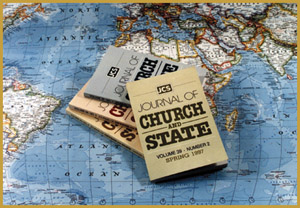
Have a look at an interesting editorial from the Baylor University's, J.M. Dawson Institute of Church-State Studies.

The author is Dr. Charles McDaniel of the University Department of Church-State Studies.

But, before you venture off to some exciting blog with scantly clad co-eds, let me temp you with my unique brand of theology.

That's right, in lieu of slightly dressed blonds, brunettes, and red-heads, I give you God and philosophy.

I have been thinking about this publication (Journal of Church and State) since reading on this very blog, Mr. Starr's post from late last night, about the James Dobson radio program.

Dr. McDaniel looks at the Iraq experiment from a totally secular and carnal angle.

Albeit it does appear that he comes down as saying that "the Iraq war is wrong", the Doctor never asks the question if Jesus Christ, or if the Holy Father, or if the Holy Spirit want a "democratized" world. Therefore, I would have to presume that he believes that the answer to these questions are either irrelevant or that it is self-evident.

What passage does one turn to for the Creator's opinion of the various carnal forms of secular government.

I appears to me that Dr. McDaniel seems to be encouraging Americans to come up with an objective standard for who we should "help" with democracy, rather than addressing the issue of humanity's need for eternal redemption.

It is a curious way of dealing with discipleship. This editorial title, Winning Hearts and Minds, is interesting, considering the fact that he's not talking about winning souls for Jesus.

What Dr. McDaniel is talking about, is instead, that "we" should be converting folks to an American economic, social, political, & cultural system.

I might ask; 'who are we'?, Should we see ourselves as citizens of the Kingdom of Heaven or as Americans? And what happens when our American citizenship opposes our Kingdom of God citizenship? Do we hold our American title close to our hearts and push the Spiritual away? Do we ever read Luke 16:13 or Matthew 6:24;

“No one can serve two masters. For you will hate one and love the other, or
be devoted to one and despise the other. You cannot serve both God and
money.”
Holy Bible : New Living Translation. 1997 . Tyndale
House: Wheaton, Ill.
The contention of Dr. McDaniel is an obvious attack on Christ's charge to the disciples in Matthew 28 and Mark 16, albeit passive, it is an attack nonetheless, on the Great Commission.

  • 15 And then he told them, “Go into all the world and preach the Good News to everyone, everywhere..."
    Holy Bible : New Living Translation. 1997 . Tyndale House: Wheaton, Ill.

Anyway, here are the scantly clad words of an American-Christian.


Winning Hearts and Minds
by Dr. Charles McDaniel


A troubling aspect to the present reconstruction of the world order is the fine line in decision-making either to "win over" or "wall off" the hearts and minds of a people. Terrorism is said to have forced our hands in these decisions; yet the criteria by which one national or ethnic group is granted entry to the global society even as others are rejected remain largely undefined. The strategic interests of the industrialized world undoubtedly are a factor, but caprice appears to influence these choices as well. Some, like the Iraqis, are selected for democratization, a process that includes the modernization of that country's institutions and major capital investments in its infrastructure. Other peoples, such as the Palestinians, are written off as a lost cause. Their fates are the internment camps like the ones being constructed by the Israeli government in its system of settlements, inaccessible highways, and concrete walls. Chechnyans, Tamils, Punjabis and many other ethnic and religious groups are potential candidates for this system that Professor Marc Ellis of Baylor's Center for American and Jewish Studies has described as "ghettoization."


How is it that Iraq was selected to become the beacon of democracy in the Middle East? Did it arrive at some undefined threshold of suffering that triggered Western (and specifically American) intervention? Does it pose a greater threat to the global order than North Korea or Iran? If Operation Iraqi Freedom was initiated for humanitarian reasons, how can we now resist intervening in the ethnic cleansing presently underway in Sudan? If it was a utilitarian decision, how much longer can we avoid action to curb the obvious threat posed by Kim Jong Il? Did American policy-makers weigh the probability of success against the investment required for Iraq's liberation and determine that Iraq is the best use of the developed world's limited democratization resources? These questions do not result from cynicism or second-guessing; they are intended to point out the need to arrive at consistent methods by which we target nations for "value reconstruction" and the necessity for constant reassessment of these efforts.
Many of the claims used to justify the Iraq War are true. Saddam Hussein was a ruthless dictator who posed a real threat not only to Iraq's neighboring states but also to populations within its borders. He exhibited the willingness to use the most heinous weapons against Iranian soldiers and even his own people and assuredly would have done the same to Israelis, Kuwaitis, Jordanians and others had he been given the opportunity. Yet the Saddams of the world have persisted throughout history. He will assume a position in the pantheon of political infamy alongside Hitler, Mussolini, Stalin, Pol Pot, Kim Jong Il, and others who, sadly but assuredly, will follow. The brutality and irrationality of particular regimes must be elements of the decision to forcibly democratize an oppressed people, but they should not be exclusive criteria.


The calculus by which we target nations for future liberation is, in certain ways, a repugnant analysis that will often defy humanitarian instincts. Utilitarianism, for example, in the project to achieve global democracy, is a necessary, albeit distasteful, tool. It involves recognition that some nations are of greater value to the global democratization effort than others. But the utilitarian approach itself will have negative consequences at least in winning the "hearts" of a people. Those left behind because their value to global strategic interests is insufficient or because the probability of success is too low will likely become the seedbed for future terrorism. This realization heightens the necessity of choosing wisely in these efforts. Moreover, it amplifies the need to better distribute the world's limited democratization resources. We need to design tertiary methods for democratic expansion to those countries where direct intervention is deemed inadvisable for whatever reasons. Failure to do so, just as the dichotomy of present decision-making (to intervene or abstain) will result in a dualistic world of good and evil and the perpetual construction of ethnic and religious ghettos.


The decision to "wall off" a people is a conscious choice to establish a perpetual enemy, irrespective of the wrongs or threats that contributed to that choice. It is a conscious judgment, not a twist of fate. It is a decision of political finality that asserts the futility of politics. Moreover, the choice to ignore one nation's need for political reconstruction renders somewhat arbitrary the decision to win over the hearts and minds of another people who, by measures beyond the national interests of developed countries, are no more deserving than those denied entry into the community of nations. Yet such painful decisions are inevitable due to the persistence of disenfranchised peoples and totalitarian regimes.


How do we go about winning the hearts and minds of a people? The first challenge in answering that question is defining exactly what we are winning them to. Liberal or illiberal democracy, a Western or Islamic economic system, a constitutional or Shariah-based legal order-any combination of these are possibilities. Lack of clarity in specifying the end-in-view may be catastrophic in its consequences. Yet Iraq and other societies targeted for reengineering must have a hand in their self-definition to achieve legitimacy and have any possibility of success. A fine balancing act is necessary in determining the degree of external definition and involvement required for the reconstruction of a nation's social institutions. The more detailed the level of involvement, the finer the balance necessary for success in winning hearts and minds. These are complex issues indeed and require the very "nuance" in decision-making that the administration has recently dismissed.


If the goal of the Iraq War is to win the hearts and minds not only of Iraqis but of all people oppressed in dictatorial or fundamentalist regimes throughout the world, then we must seek multiple vantages from which to observe our efforts with some detachment. We must attempt to assess this infinitely complex project not only from the perspective of those being democratized but also from the viewpoints of those left behind and even those who are hostile toward it. The "opportunity cost" of the Iraq War is that of not distributing democratization resources to other countries in similar straits. Moreover, we must ask whether institutional reconstruction of selected countries is either wise or, more crassly, cost effective. In both spreading democracy and eradicating terrorism, is it prudent to place so many of our eggs in the basket of Iraq? More importantly, is it possible that our sheer determination will be our undoing-that American involvement in the reconstruction of Iraq's civil and political institutions will ultimately backfire for its cultural ignorance and excessive confidence in the power of collective reason? Many of those now supporting American participation in the institutional reconstruction of Iraq are of the same political ilk as their conservative predecessors who correctly professed the impossibility of the centrally planned state. Cultural reengineering projects on such a grand scale are rarely successful in history.


The immediate decision has been made. We are in Iraq and will remain there until something has been accomplished. But the ongoing and noble enterprise of spreading freedom in the world must deal with massive cultural complexities; thus, it will require constant reassessment and revision to changing circumstances. Political concerns may work to stymie that objective analysis. Election campaigns will place a premium on the need to paint rosy our efforts in Iraq and elsewhere, regardless of realities. Domestic politics, therefore, emerges as perhaps as great a threat as fundamentalist factions or mass anti-Western sentiments to the success of these foreign policy initiatives. It would be ironic indeed if candor regarding our successes and failures becomes the ultimate casualty in the campaign to spread freedom and democracy. And it will be tragic if the desire to "save face" in Iraq perpetuates policy dogmatics that prevent necessary adaptation along the learning curve of democratization.